
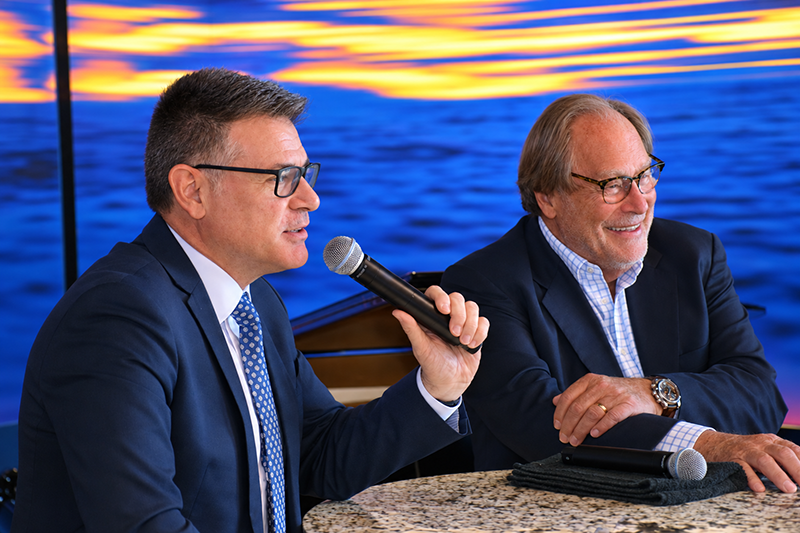
Committee for Melbourne’s Leadership Luncheon with Geoff Slade
Committee for Melbourne’s Leadership Luncheons bring together leaders from across business, civic and cultural life for the conversations that matter – candid, thoughtful exchanges that help shape Melbourne’s long-term future.
Held at the Peter and Ruth McMullin Beacon at Melbourne Recital Centre, this month’s Leadership Luncheon with Geoff Slade, Executive Chairman of Slade Group, TRANSEARCH International Australia and Yellow Folder Research, offered members the opportunity to hear from one of Australia’s most experienced figures in recruitment, talent advisory and executive search.
Hosted by Committee for Melbourne, the event brought together a broad cross-section of Melbourne’s leadership community, including representatives from major universities, government, banking, member organisations, not-for-profits, professional services, media, infrastructure, insurance, education, recruitment and advisory firms.
It was a fitting reflection of Committee for Melbourne’s role as a forum where leaders from different sectors can connect, exchange ideas and contribute to the city’s future prosperity, liveability and global standing.
A career shaped by curiosity, resilience and relationships
In conversation with Agostino Giramondo, Acting Chief Executive and General Manager, Committee for Melbourne, Geoff reflected on a career spanning more than five decades. Beginning in 1967 in a modest office on the corner of Collins and Elizabeth Streets, his story was one of persistence, risk-taking and reinvention.
Geoff’s path into recruitment was shaped by both circumstance and instinct. After early experience in industrial relations, he was offered a role by John R. Waite, one of the founding figures in Australia’s recruitment industry. When Waite tragically died before the role could begin, Geoff decided to start his own employment agency, borrowing $300 from his mother.
It was a small but significant act of belief, and a reminder that Geoff’s business journey, like many entrepreneurial stories, was shaped not only by personal drive but by the support and confidence of those closest to him. Geoff also acknowledges the support and influence of his wife, Anita Ziemer, over many years, who has been part of the broader success story behind his businesses.
Geoff’s first placement – an accountant at Containers Limited, now part of Amcor – helped pay the second month’s rent. It would take seven years before the business made what he described as a real profit.
When that moment finally arrived, Geoff marked it in memorable fashion: buying a brand new Porsche Carrera for $14,200. He recalled feeling like “king of the kids” at the time, helped no doubt by the fact the car was canary yellow. Years later, he joked he wished he had kept it after seeing a similar model advertised recently for $600,000.
There was a strong sense throughout the discussion that Geoff’s career has been shaped as much by curiosity as by commercial instinct. He spoke about the importance of investing in learning, recalling his decision to travel regularly to global staffing conferences in the United States to bring new thinking back to Australia. As he put it, “I figured that if I could learn one thing that I could bring back and put into play here, it would pay dividends.”
In a world of accelerating disruption, his advice to people building their careers was direct: “I think firstly they can invest in themselves.”
That mindset became one of the defining themes of the conversation. Geoff has seen the recruitment industry move from newspaper advertisements, once described as “rivers of gold” for the revenue they generated for the media, to the arrival of SEEK around the year 2000 and now the accelerating impact of artificial intelligence. Between SEEK and AI, LinkedIn has also reshaped the recruitment landscape, changing how candidates present themselves, how employers access talent and how search firms map leadership markets.
Geoff shared one recent example of three identical AI-generated applications for a $400,000 role – a telling reminder that while technology can increase speed and access, it does not replace a candidate’s ability to differentiate themselves in the employment market.
Football as a leadership lens, not the whole story
AFL featured prominently in the conversation, as it has in Geoff’s life and career. From his early playing days with Melbourne Football Club to his later involvement as an owner and interim CEO at the Sydney Swans, football has clearly helped shape his views on leadership, teamwork and culture. Learning from his experience at Melbourne FC, he became aware that not quite making the grade isn’t necessarily the end of one’s ambitions – something he has put to good use in identifying talent over the years. His personal connection to the game has also extended through his family, with Geoff noting that his son played for Geelong (the reason he became a Geelong supporter).
Geoff’s professional work across the sport has included recruiting Brian Cook for Geelong Football Club, with Cook going on to become the longest-serving CEO in AFL history. More recently, TRANSEARCH Australia has supported Richmond Football Club with the recruitment of its CEO and other senior roles, as well as senior appointments at Melbourne FC.
While this was not a football event, Geoff’s footy stories served as memorable examples of broader leadership principles, particularly the way leadership styles have evolved over time. He reflected on Ron Barassi’s evolution as a coach, noting that earlier command-and-control approaches were less effective with younger players, while later in his career Barassi had adapted and become a more effective leader.
The lesson carried well beyond sport. Leadership today requires more than authority or technical knowledge. “I think in a word, EQ has become vitally important,” Geoff said.
Whether leading a football club or a professional services group, the expectations placed on leaders have changed. The ability to inspire, listen, adapt and bring people on the journey with you is now central to leadership effectiveness.
Geoff captured this point when discussing contemporary leadership: “I think you’ve got to be able to translate that passion to your team. You’ve got to take the good with the bad… and you must be prepared to be flexible.”
Character, trust and the quality of leadership decisions
As one of Australia’s most recognisable recruitment leaders, Geoff offered valuable insight into how employers’ expectations have shifted over time. Talent remains important, but the conversation repeatedly returned to character.
When asked about the importance of character in recruitment, Geoff was unequivocal: “I think it’s very important.” He added that assessing character requires careful interviewing and more than one interaction: “You have to ask the right questions to try and determine where someone sits in terms of character.”
For organisations navigating increasingly complex talent markets, this was a particularly relevant message. Leadership appointments carry long-term consequences, and significant cost. The best decisions require more than a polished CV or strong interview performance. Aside from reference checking or psychometric assessments, organisations need to be able to uncover a deep understanding of the person behind the profile.
This emphasis on character also connected strongly to one of Geoff’s central beliefs: relationships remain fundamental to business success.
“If you ask me what is the one thing that will pretty much ensure you will be successful in business today, I think it’s that ability to build relationships that makes the difference,” he said.
Geoff illustrated the point with a story from earlier in his career, when he ran regularly around ‘The Tan’ with the CEO of a major ASX listed Resources company. Through spending time with him and building trust, he developed a strong working relationship and eventually a lasting friendship. It was a practical reminder that relationships are rarely built through convenience or transaction.
In an era where communication is often mediated through screens, this message felt especially relevant. For Geoff, relationships are not built through email or phone calls alone. They are built through presence, curiosity and the willingness to invest in people beyond the immediate commercial opportunity.
A conversation about Melbourne’s future
While Geoff spoke candidly about business confidence and the conditions facing Victorian organisations, the broader conversation remained focused on what Melbourne needs to thrive: encouragement for enterprise, support for entrepreneurship, confidence in the future and leadership capable of looking beyond short-term cycles.
When asked what he would focus on if he were in charge, Geoff pointed to the importance of encouraging business and entrepreneurs.
That belief is also personal. Geoff noted that three of his children are entrepreneurs. It was a reminder that Geoff’s interest in enterprise is not only professional, but also connected to family, opportunity and the next generation of business builders.
That perspective aligned naturally with the purpose of Committee for Melbourne and the broader objectives of the Victorian Chamber of Commerce and Industry: bringing together leaders from across sectors to engage in frank discussion, exchange ideas and contribute to the long-term prosperity and liveability of the city.
The setting itself reinforced that future-focused lens. Melbourne Recital Centre sits within a precinct undergoing significant transformation. Sally Curtain, Chief Executive of the Victorian Chamber, also brought the conversation back to Melbourne’s future, speaking about the opportunity presented by the Melbourne Arts Precinct. Looking out from the venue, she pointed to the cranes and development underway, describing the precinct as incredibly exciting for the state and highlighting Melbourne’s status as a world-class cultural and sporting destination. It was a reminder of the many outstanding entertainment assets that are part of the city’s identity.
Learning, adaptation and human connection
When asked to name the most impressive Australian leader he had encountered, Geoff pointed to Malcolm Jackman, former chief executive of Elders and Coates Hire. While Jackman may not be widely known outside Australian business circles, his impact was significant.
Geoff recalled placing him into Coates Hire as CEO when the company’s shares were trading at 80 cents. Five years later, the business had grown substantially, with shares reaching $7.50 before the company was sold to private equity. For Geoff, Jackman’s impact reflected the qualities he had returned to throughout the luncheon: commercial judgement, energy, salesmanship and the ability to inspire people.
Geoff Slade’s career has traversed business, recruitment, sport and civic life. His stories were personal, often humorous and grounded in lived experience. But the lasting message was broader than any one industry or chapter of his career: leadership is built through curiosity, trust, adaptability and the courage to keep learning.
For Melbourne, those are the qualities that will help businesses navigate uncertainty, strengthen the leadership of organisations and continue shaping the city and the state’s long-term future.
Thank you to Agostino Giramondo and Committee for Melbourne for hosting the event, Sally Curtain, and the Victorian Chamber of Commerce and Industry, and everyone in the room who contributed to the conversation.

Chris Toussaint is a marketing and communications professional specialising in recruitment, executive search, talent management, learning & development and human resources environments.