
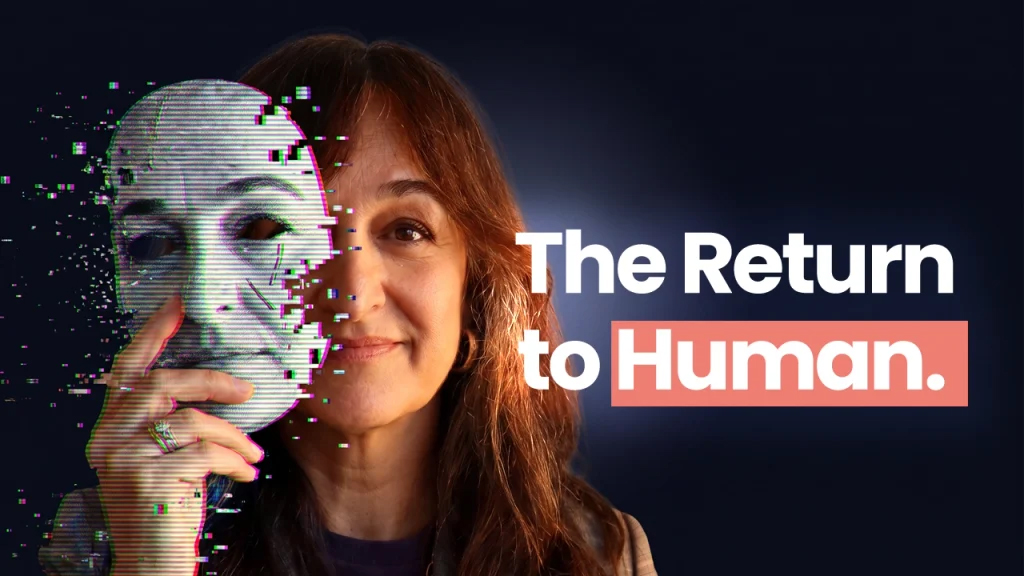
What if confidence isn’t the thing holding you back? I’m sharing what I’m seeing in the job market right now, from executive presence and relatability to why being more human may be your biggest advantage in the age of AI.
Confidence has become one of the most common explanations experienced professionals give me when their careers stall.
“I need to be more confident.”
“I’ve lost my confidence.”
“I don’t think I come across confidently enough in interviews.”
I hear versions of these statements every week from people with 15 or 20+ years of professional experience. They have managed teams, delivered complex projects, advised executives and built careers that demonstrate considerable competence. Yet when they enter a job search or begin aiming for a more senior role, confidence suddenly becomes the diagnosis. Increasingly, I think we may be diagnosing the wrong problem.
The professionals who stand out today are not necessarily the people projecting the greatest certainty. Often, they are the ones who communicate with enough self-awareness to be credible, enough courage to be visible and enough humanity to be memorable. And in an employment market increasingly saturated with AI-assisted communication, those qualities may become considerably more valuable.
Confidence and Competence are not the Same Thing
We have spent decades associating professional credibility with certainty. Executives are expected to have answers. Candidates are encouraged to “sell themselves.” Job seekers are told to project confidence in interviews. Leadership advice frequently emphasizes gravitas, authority and commanding a room.
There is some logic to this. People need to trust those they hire and follow. But confidence is an imperfect proxy for competence. Research into personnel selection has even shown how confidence can distort hiring decisions. One study published in Organizational Behavior and Human Decision Processes found that unstructured interview information increased decision-makers’ confidence in their judgments without necessarily making those judgments more accurate.
That distinction matters. When an experienced professional tells me they lack confidence, I often find something quite different once we begin working together. They know they can do the job. What they may lack is the courage to pursue it. They may struggle to articulate their value. They may not know how to translate 20 years of experience into a concise proposition for the next stage of their career. Or they may be attempting to perform a version of seniority that does not feel like them.
Those are different problems, requiring different solutions.
Executive Presence is Often Misunderstood
I was reminded of this recently when I spoke to a group of almost 70 senior and highly experienced women working in technology. My presentation examined five career barriers I see regularly: confidence, courage, executive presence, tall poppy syndrome and imposter syndrome. After the event, attendees were surveyed about the subject they most wanted to explore further. Executive presence came first. That result did not surprise me. Many highly accomplished professionals are asking themselves some version of the same questions:
Do I appear senior enough?
Do I sound strategic enough?
Do I have enough gravitas?
Can I command the room?
The danger begins when they conclude that executive presence requires them to imitate somebody who already seems to possess it. We have often described executive presence through qualities including gravitas, communication, decisiveness, integrity, inclusiveness and the ability to read an audience. Importantly, authenticity also appears in that discussion. That last point deserves more attention.
Executive presence does not require every leader to communicate in the same way. A quiet, thoughtful executive can have presence. So can an energetic extrovert. A leader can be warm, humorous or reflective. They can acknowledge uncertainty. They can admit that something has been difficult. The goal is not to manufacture a more impressive personality. It is to become much better at communicating through the strengths and characteristics you already possess, while continuing to develop the behaviours the next stage of your career requires.
There is an important distinction between authenticity and refusing to grow. Research and commentary on authentic leadership increasingly recognise this tension. London Business School professor Herminia Ibarra has argued that professional growth sometimes requires experimenting with behaviours that initially feel uncomfortable until they become part of a broader, more capable version of ourselves. That is very different from adopting an artificial professional persona.
Relatability is Becoming a Professional Advantage
I have noticed this shift in my own work. Earlier this year, I made a deliberate decision to communicate my expertise more clearly. I wanted stronger opinions and greater precision in the career advice I shared publicly. At the same time, something unexpected happened. My writing became more personal. In my newsletter, I began discussing experiences affecting me personally and connecting them with patterns I was seeing among clients. The response changed. Open rates increased. More people replied. More people contacted me about working together.
It reinforced something I had already begun noticing:
Being relatable can be more persuasive than appearing confident all the time.
This does not mean oversharing or turning professional communication into confession. Effective vulnerability requires judgment. Recent commentary on leadership presence has made a similar distinction: vulnerability is most effective when it is relevant, intentional and accompanied by emotional composure. Used well, it can increase trust rather than diminish authority.
For job seekers, this matters because recruitment is fundamentally an exercise in trust. A hiring manager is not simply asking whether you have the technical qualifications. They are asking themselves whether they believe you. understand you, imagine working with you, and trust how you will behave when things become difficult.
Polish can contribute to that impression. Perfection rarely does.
AI is Changing What Feels Valuable
There is another force making this more important: artificial intelligence. A professional can now produce a polished CV, cover letter, LinkedIn post, networking message or interview response within minutes. That has obvious benefits. I use AI myself and encourage clients to understand how to use it well. But when everybody has access to the same capability, the value equation changes.
What happens when polished writing becomes abundant? The scarce element becomes human judgment. A carefully considered application becomes more noticeable. An original point of view becomes more valuable. A thoughtful conversation becomes harder to replace. The candidate who can explain an unusual career decision in their own words becomes more memorable than the candidate delivering an immaculate but generic response.
This is why I think being human is becoming a career advantage in the age of AI. AI can help organize your thoughts. It can challenge your assumptions and improve a draft. But your professional identity still has to come from somewhere. If your CV, LinkedIn profile, networking messages and interview responses are all generated without deep personal input, the risk is not simply that they “sound like AI.” The greater risk is that they stop sounding like you.
The New Career Luxury is Control
This connects with another cultural shift I have been watching closely. Luxury is increasingly associated with things that require time. Physical books. Vinyl records. Film cameras. Long conversations. Craftsmanship. Experiences that deliberately resist optimization. There may be a career equivalent.
One of the greatest professional luxuries is having enough control over your career that you do not have to panic. It is being made redundant and deciding not to submit 50 applications that evening. It is taking several weeks to decide what you actually want. It is declining an opportunity that looks impressive but takes you in the wrong direction. It is having enough self-knowledge to know that the job everybody expects you to want is not actually the job you want.
Not everybody has the financial flexibility to do this, which is precisely why it is a form of privilege. But even within constraints, the principle matters. The ability to make deliberate rather than purely reactive career decisions is increasingly valuable. I see this particularly among experienced professionals who are reconsidering what ambition means to them. Some still want the C-suite. Others want flexibility, autonomy, consulting work, portfolio careers, more travel or simply fewer years spent doing work they no longer find meaningful. Neither is inherently more ambitious.
The question is whether the choice is intentional.
Human Expertise is Becoming More Valuable, Not Less
There is an assumption that access to AI should reduce the need for advisers, coaches and other experts. My experience has been almost the opposite.
Information has never been more accessible. Anyone can ask an AI tool a career question. There are thousands of free articles, videos and podcasts explaining how to write a CV or prepare for an interview. My own The Job Hunting Podcast now contains hundreds of episodes of free career advice. Yet people continue to invest in private career coaching and professional career services.
I don’t think they are primarily paying for information. They are paying for judgment, attention, context, and a conversation that is entirely about them. They are paying for somebody to remember what they said three weeks ago and notice that today they are describing their ambitions differently.
Information can be automated remarkably well. Attention is much harder to automate.
You May Not Need to Reinvent Yourself
These ideas may appear separate: confidence, executive presence, relatability, AI and the desire for greater control over our careers. I think they point in the same direction. We are entering a period in which professional polish is extraordinarily easy to manufacture.
That may make what cannot easily be manufactured more valuable. Judgment. Self-awareness. Original thinking. Human connection. The ability to communicate without hiding behind a professional persona.
For experienced professionals, that could be liberating. You may not need to reinvent yourself into a shinier, more confident candidate. You may need to understand yourself better. Trust your experience more. Become clearer about what you want. And allow more of the actual human being behind the CV, LinkedIn profile and job title to enter the conversation. That might be a far more compelling form of confidence.
This article was originally published on The Job Hunting Podcast. Click here to see the episode.

Renata Bernarde is a career coach, podcast host, and former corporate executive. She works with professionals in their 40s, 50s, and 60s to help them secure new roles, change careers, and advance in leadership. Renata hosts The Job Hunting Podcast and teaches career planning at Monash University. Learn more at renatabernarde.com.