
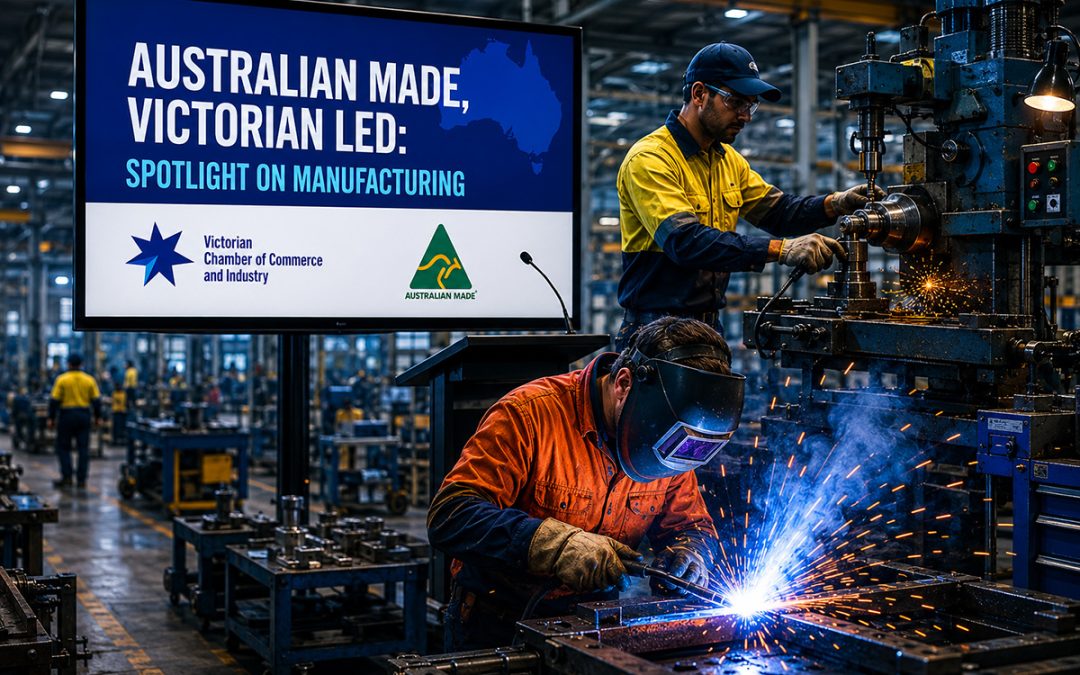
Last week I attended the Australian Made, Victorian Led: Spotlight on Manufacturing event hosted by the Victorian Chamber of Commerce and Industry in Melbourne, which reinforced something that is becoming increasingly clear across industry:
Australian manufacturing is not standing still.
Across the room were businesses, leaders, operators, educators, and professionals all contributing to a sector that continues to evolve, modernise and grow – despite ongoing economic and global pressures.
What made the event particularly valuable was the diversity of experience and perspective of those in attendance. From advanced manufacturing through to infrastructure, logistics, supply chain, engineering and skilled trades, there was a clear shared focus on strengthening sovereign capability and building sustainable long-term industry growth.
One of the strongest themes throughout the event was workforce development. Businesses are no longer simply competing for talent. They are competing for capability.
The demand for skilled labour across manufacturing is accelerating. With that comes a growing requirement for qualified tradespeople and certified technical capability. Trade certificates, apprenticeships and vocational pathways are becoming increasingly critical to the future of Australian industry.
This is where the conversation becomes more important.
For years, there has been significant emphasis placed on university pathways, while trade and industrial sectors quietly remained the backbone of much of Australia’s economy. What is now becoming evident is that manufacturing growth cannot occur without investment into trades, technical education and the hands-on operational expertise that keeps industry moving.
The reality is straightforward: You cannot scale infrastructure, logistics, production, energy, defence, or industrial operations without skilled people on the ground.
Another key takeaway from the event was the importance of Australian-made capability in creating long-term job security. Strong domestic manufacturing supports far more than production output alone. It strengthens supply chains, drives innovation, creates stable employment opportunities and reduces dependence on offshore markets during periods of uncertainty. Ongoing global conflicts and resulting disruptions to fuel and freight networks have reinforced just how important resilient local manufacturing and supply chain capability are to Australia’s economic stability and future security.
Victoria in particular continues to position itself as a major contributor to that future, with significant momentum across manufacturing, construction, industrial technology and sectors dependent on infrastructure-led investment.
Events like this matter because they bring the right people together – engaging industry leaders, emerging talent, educators and businesses to have practical conversations about where Australia is heading and what needs to happen next.
Congratulations to everyone involved in organising and contributing to the event. The energy in the room reflected a sector with genuine momentum, and it was encouraging to see manufacturing receiving the attention it deserves as a critical pillar of Australia’s economic future.
As a consultant working closely with both organisations and professionals in these sectors, I am seeing a significant increase in demand for high-performing talent within Supply Chain, Operations, Procurement, Logistics, Warehousing, Continuous Improvement and Manufacturing leadership. If you’d like a confidential discussion about the market or your hiring and career plans, feel free to get in touch.

Ross Bealin brings over a decade of experience across recruitment, business development and supply chain operations. His background in transport, logistics and sales provides a strong operational understanding of how supply chains function, enabling him to deliver commercially aligned recruitment outcomes. Known for his commitment to quality, integrity and consistent results, Ross takes a consultative approach, aligning recruitment strategies with broader business objectives. He has developed strong industry networks and is focused on building long-term partnerships with both clients and candidates. Read more…